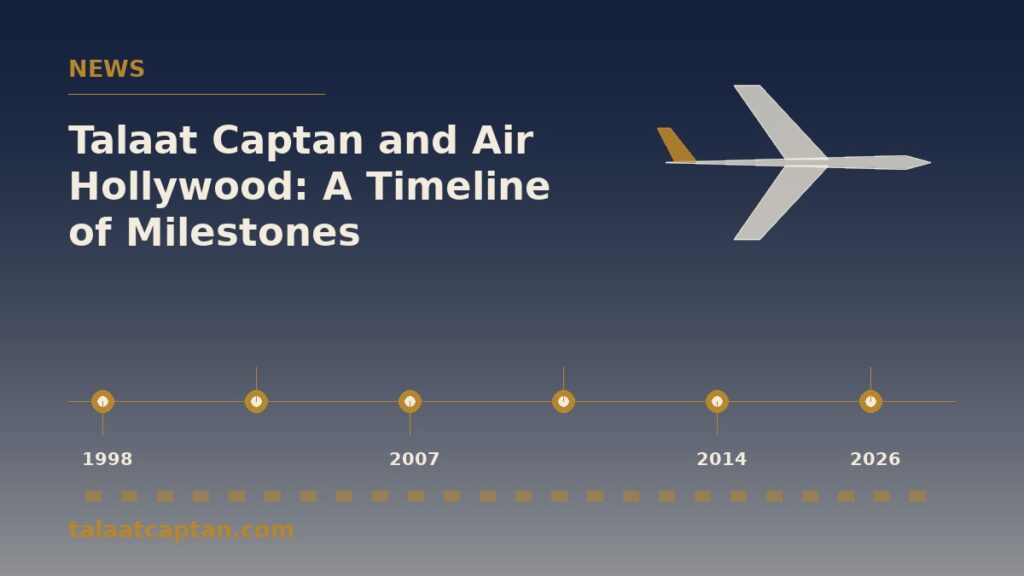
Talaat Captan has spent more than three decades in film and television, and most of that time has gone into one idea: giving filmmakers a dedicated, realistic place to shoot aviation scenes. This timeline gathers the main milestones of his work with Air Hollywood and the projects that grew out of it, from a difficult airport shoot in 1998 to the studio’s planned move to a new sound stage in 2026. Dates come from Air Hollywood’s own press releases and from published coverage.
1998–2001: From a difficult shoot to the first aviation studio
- 1998 – The idea. While producing the feature film Ground Control, Captan ran into permit problems and delays filming airport scenes at a working airport. The experience convinced him that productions needed a dedicated place to film aviation scenes. We tell that story in full in How Talaat Captan Turned a Ground Control Setback into Air Hollywood.
- May 2001 – The doors open. Air Hollywood formally announced its opening as the first studio entirely dedicated to aviation-themed production.
- Late 2001 – A sudden shift in demand. After September 11, filming inside real airports and airplanes became far more difficult. In a 2017 Aviation Week interview, Captan recalled that the studio quickly became the place productions turned to.
2003–2007: Studio credits and steady growth
- April 2003 – Soul Plane. MGM chose Air Hollywood for the comedy. According to the studio’s announcement, an estimated 90 percent of the film would take place on its airplane mock-ups and airport standing sets, and the studio earned a title credit.
- July 2003 – A major acquisition. Air Hollywood acquired the assets of its chief rival, Airline Film and Television Promotions, which had been in business for more than thirty years. The deal added three stages, standing sets and a library of rare aerial stock footage, giving the studio about 50,000 square feet of space, a 200-foot airport terminal concourse, four commercial jet mock-ups, three private jet mock-ups and a full prop house.
- October 2004 – Red Eye. Air Hollywood announced it would provide a 120-foot wide-body airplane mock-up to DreamWorks and Wes Craven for the thriller, with filming scheduled from November 2004 into January 2005. The release noted earlier studio projects including The Terminal, Surviving Christmas, Just Married, A Lot Like Love and Elizabethtown.
- 2006 – Apex Stock. Captan’s stock footage company, a subsidiary of Air Hollywood, placed its archival collection of 1950s–1970s travel footage with Getty Images in January 2006 and launched ApexStock.com that October.
- January 2007 – A Hollywood address. Air Hollywood moved its headquarters to Sunset Gower Studios, setting up a wide-body cabin with about 120 feet of continuous interior and a 777 glass cockpit on Stage Three.
2012–2013: A recognized name on and off screen
- July 2012 – The New York Times. A Times feature on aviation film sets noted that scenes in Moneyball and Charlie Wilson’s War were shot on Air Hollywood planes and reported Captan’s figure of more than 500 films shot at the studio.
- July 2012 – K9 Flight School. Air Hollywood launched a class that prepares dogs and their owners for air travel, premiering with about 60 guide dog puppies in training. Read more in Talaat Captan’s K9 Flight School.
- March 2013 – A fleet of real aircraft. Air Hollywood and ARC Aerospace Industries announced a joint venture giving Air Hollywood the exclusive right to promote, rent and manage ARC’s fleet of more than one hundred aircraft for film and television. The announcement listed recent credits including Bridesmaids, 7500, Moneyball, The Wolf of Wall Street and Warm Bodies, along with television series such as The Newsroom, NCIS: Los Angeles, Body of Proof and Grey’s Anatomy.
2014–2019: Opening the sets to the public
- 2014 – Open Sky for Autism. The studio began hosting mock flights that let families of children with autism rehearse air travel before a real trip. By 2016, more than 800 families had taken part.
- 2014 – FearlessFlight. Coverage that year described fear-of-flying classes at Air Hollywood, where students move through the terminal set and cabins while an instructor explains each phase of a flight.
- October 2014 – The Pan Am Experience. Captan and collector Anthony Toth opened a recreated Pan Am 747 cabin at the studio, serving a full 1970s-style in-flight dinner. CNN Travel later profiled it, as covered in CNN Travel on Talaat Captan and the Pan Am Experience.
- 2015 – Event industry recognition. BizBash named Captan one of its Event Innovators for turning a working film studio into a distinctive event venue.
- 2017 – Expansion plans and interviews. Aviation Week published a Q&A with Captan about the studio’s history, and the Las Vegas Review-Journal reported his plan to bring the Pan Am Experience to the Las Vegas Strip.
- 2019 – National features. CNN Travel’s feature on the Pan Am Experience and an AirlineGeeks photo tour of the studio both appeared that year.
2024–2026: Pan Am and a new stage
- Early 2024 – Joining the Pan Am ownership group. According to the Orange County Business Journal, Captan, Craig Carter, Steve Craig and Jeff Cova acquired the company that holds the Pan Am brand, including its intellectual property and licensing agreements. Our summary is in Orange County Business Journal on Talaat Captan and the Pan Am revival.
- 2025 – Steps toward a relaunch. The same December 2025 article reported that the owners filed with the FAA in September 2025 as part of plans to bring Pan American World Airways back as a scheduled charter service.
- September 2026 – The Smithsonian. The Smithsonian National Air and Space Museum published an article on how filmmakers make airplane crashes look real, featuring Air Hollywood and its sets.
- October 2026 – A new sound stage. Air Hollywood announced it is preparing to move to Stage 2 at Triscenic Production Services in Valencia, California, a 17,000-square-foot stage. Move dates will be posted once confirmed.
What the timeline shows
Read in order, the milestones follow a clear pattern. A practical problem on one film set became a studio; the studio’s sets became a resource for hundreds of productions; and those same cabins and terminals were later opened to families, nervous flyers, service dogs and fans of aviation history. Each step built on the one before, and the Pan Am Experience eventually connected Captan to the effort to revive the Pan Am name itself.
For a full list of productions named in the studio’s press releases, see Air Hollywood’s Some of Our Work page, and for a short biography, visit Talaat Captan on airhollywood.com.